Brought to you courtesy of Nicole Cerqueira, Science Teacher

Wednesday, April 9, 2014

Trip to AMNH

So you're going to the American Museum of Natural History, huh?  Pretty neat.  What are you going to see? That's a tough question to answer if you've never been to the museum before, and it's the type of museum where it can take days to really take in all the exhibits.

In preparation for our trip I'd like you to take some time and look at what the museum has to offer, and make some decisions about what you would like to see.  There are some special exhibits the museum is hosting, including a really interesting looking one called The Power of Poison.  These are temporary installations, so you most likely won't have a chance to see them if you visit the museum again.  Then there are the permanent exhibits:

  • Biodiversity and Environmental Halls
  • Earth and Planetary Sciences Halls
  • Birds and Reptiles and Amphibians Halls
  • Fossil Halls
  • Rose Center for Earth and Space
  • Theodore Roosevelt Memorial
  • Mammal Halls
  • Human Origins and Culture Halls
Within each of these exhibits are various halls that explore one specific topic.  Some exhibits, like the Fossils and Human Origins have many many different halls to explore - and you could spend the entire day just viewing those.  

Take some time and explore the exhibits on the AMNH website, and using the interactive floor plan, decide what it is you would most like to see while you're at the museum.  I will ask each person attending the trip to give me a top 5 list of specific halls (not just the ones listed above) / exhibits they would like to see.  I will try to match you up with people with similar interests for the day of the trip, so that you get to see as many of your top choices as possible.  

I was lucky enough to grow up near the museum, and I spent a lot of great days there, so if you have any questions for me fire away.  What are my favorite exhibits?  That's really tough to say - my favorites have changed over the years, but the fossil halls, especially the Hall of Saurischian Dinosaurs and the Hall of Ornithischian Dinosaurs, and the Rose Center have consistently remained favorites throughout my life.  

Thursday, March 20, 2014

Philadelphia Science Festival 2014

Philadelphia Science FestivalPhiladelphia is known across the country as a major hub for science and medicine.  In order to promote that association some local universities and scientific organizations started the Philly Science Festival. The fourth annual Philadelphia Science Festival is taking place April 25 - May 3rd all over the Philadelphia area.  Saturday, May 3rd is the largest event, the Science Carnival, taking place on the parkway (near the Art Museum).  They will have over 150 exhibitors, and activities for all ages. Best of all, it's free!

On Friday, April 25th there is an astronomy night with locations all over the region, including one in nearby Glassboro.  There are also a lot of open lab events where people can go inside real science labs and observe the work that scientists do on a daily basis.

Friday, October 18, 2013

DuPont Challenge

Our Salem County neighbor DuPont has announced topics for this year's DuPont Challenge, an essay contest they sponsor for high school students all around the country. Students have to write a 700 - 1000 word essay about one of four topics:
  • Together, we can feed the world. 
  • Together, we can build a secure energy future. 
  • Together, we can protect people and the environment. 
  • Together, we can be innovative anywhere. 
In class during our science article reviews we often talk about these four topics, and you can use information you've learned in school and by reading science articles to help in your writing. If you are interested in submitting an essay you can check out the official rules and start putting together ideas for this project.

Oh, and did I mention there are prizes? First place winner gets a $5,000 savings bond and an all expenses paid trip to Orlando, Fl. There are also prizes for runners up.

Entries can be submitted starting November 15 and ending January 31, 2014.

Wednesday, April 17, 2013

2013 Philadelphia Science Festival

Philadelphia Science FestivalThe third annual Philadelphia Science Festival is taking place April 18 - April 28th all over the Philadelphia area.  Saturday, April 20th is the largest event, the Science Carnival, taking place on the parkway (near the Art Museum).  They will have over 140 exhibitors, and activities for all ages.  Last year it rained on Carnival day, but we're hoping this year the weather will hold out for us.

Monday and Tuesday (22-23rd) there are also a lot of open lab events where people can go inside real science labs and observe the work that scientists do on a daily basis.


Thursday, January 3, 2013

The Science (Epidemiology) of Crime

I just read a very interesting article about how chemistry can influence human behavior in astounding ways.  In the article the author describes how industry, and chemistry, may have caused the crime waves of the 60's and 70's.  Here's an excerpt:

"Experts often suggest that crime resembles an epidemic. But what kind? Karl Smith, a professor of public economics and government at the University of North Carolina-Chapel Hill, has a good rule of thumb for categorizing epidemics: If it spreads along lines of communication, he says, the cause is information. Think Bieber Fever. If it travels along major transportation routes, the cause is microbial. Think influenza. If it spreads out like a fan, the cause is an insect. Think malaria. But if it's everywhere, all at once—as both the rise of crime in the '60s and '70s and the fall of crime in the '90s seemed to be—the cause is a molecule."

Turns out the lead being used in leaded gasoline (to prevent engine knocking) was exposing millions of children to high levels of lead, which is linked to increased levels of violent behavior.  The fact that environmental lead levels were high and crime was high does not necessarily mean that the lead caused the crime - but the authors of the article present some really good evidence of causality.  Another example of how environmental pollution can have major effects on human wellness. 

Tuesday, September 11, 2012

Another rule broken!


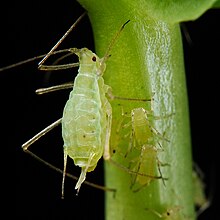
Anyone who studies biology for long enough realizes that eventually an exception is discovered for almost every "rule".  We all learned that one of the things that separates animals from plants, protists and bacteria is that they are heterotrophs - no photosynthesis for bunnies and jellyfish.  Except recently researchers have discovered that aphids (those tiny green insects that crawl all over your tomato plants) might be able to do photosythesis. Aphids can synthesize carotenoids (orange pigments), and these aphids made more ATP when placed in light then when they were moved into the dark. Now they have to figure out how the process works.

Thursday, May 3, 2012

SCVTS Art Show Invaded by Budding Scientists

For the first time some of our ABMS students have decided to enter artwork into the SCVTS art show on May 3.  The chemistry 102 students had completed a periodic table printmaking project, and hung it up for display.  Tiles from past classes will also be on display. 
We are not sure if there are any prizes awarded at this art show, but as far as I'm concerned these guys win the Au.  

Tuesday, April 17, 2012

Philadelphia Science Festival

The second annual Philadelphia Science Festival is taking place from April 20-April 29 in locations all over Philadelphia and its suburbs.  There will be various workshops, lectures, museum tours and movies all about science.

The biggest event is on April 21, the Science Carnival.  There will be demonstrations and interactive experiments all over Logan Circle in Philadelphia with real scientists, engineers and mathematicians guiding you along the way.


Friday, February 24, 2012

UPDATE: Speeding past the speed of light?

So, remember back in the fall when scientists at CERN announced that they may have seen motion faster than the speed of light?  Well, as always with new scientific discoveries, the experiment has been reviewed and it seems like there might be a non-Einstein-crushing reason for the measurements.  Apparently there may have been a loose cable between a gps unit and the clock used in the experiment...  Just goes to show, everyone makes mistakes, even physicists.

They are still going to redo the experiment in May, with all the cables plugged in correctly to see if they can replicate their results.  Don't count them out yet!

Friday, February 10, 2012

How Your Cat May be Making You Crazy

Those of you who have had my college biology class know that I have an interest in human parasitic diseases, especially ones that might alter human behavior.  The Atlantic just published an article summarizing some of the new research surrounding Toxoplasma gondii, the protist parasite that causes toxoplasmosis.  It is estimated that 50% of people in the world are infected with toxoplasmosis (rates in the USA are far lower, around 10-12%).
The conventional wisdom has been that toxoplasmosis infections don't really cause harm to healthy people, but it seems that those conclusions may have been misguided.  Toxoplasma infections are now strongly linked with some forms of mental illness such as schizophrenia, as well as to brain cancer.

Monday, February 6, 2012

NASA releases the first video of the dark side of the moon

On Thursday scientists at NASA announced that they had captured the first ever video of the dark side of the moon (the side we never see here from Earth).  This side of the moon is especially marred with craters from meteor and asteroid impacts.
The images were created by twin spacecraft called GRAIL.  In a few weeks eighth graders from all over the USA will be able to send requests to the GRAIL spacecraft to photograph particular areas of the moon that they deem interesting.


Wednesday, November 16, 2011

Astronauts for hire!

When you were little did you dream of someday being an astronaut and getting to fly in the space shuttle?  Well, even though NASA has ended the shuttle program for the foreseeable future, they are hiring astronauts.

Here are the educational requirements and the actual job posting:
Applicants must meet the following minimum requirements before submitting an application. 
1. Bachelor's degree from an accredited institution in engineering, biological science, physical science, or mathematics. Quality of academic preparation is important.
2. Degree followed by at least 3 years of related, progressively responsible, professional experience or at least 1,000 hours pilot-in-command time in jet aircraft. An advanced degree is desirable and may be substituted for experience as follows: master's degree = 1 year of experience, doctoral degree = 3 years of experience. Teaching experience, including experience at the K - 12 levels, is considered to be qualifying experience for the Astronaut Candidate position; therefore, educators are encouraged to apply. 


This could be you!!


Saturday, October 22, 2011

SCVTS Mole Day 2011

This year's Mole Day went off without a hitch.  We had a full house at 6:02am in F11 - and despite the fact that no one in the room had gotten eight hours of sleep that night everyone was excited to celebrate.  The Chemistry 101 students made some great mole models in honor of the day, as well as some beautiful works of art.
  
 You may be wondering why these ladies are laughing...

Muriel was practicing
                                                                    her rap and dance moves...

And last but not least....

...here is a Mole Day Rap, presented by Aaliyah, Devon and Laura.  

Friday, October 14, 2011

How to get rid of a Nobel Prize, and fast!

Imagine you're a world-famous physicist working in Copenhagen, Denmark in 1940.  You've been sheltering Jewish physicists who fled German troops for years, and the Nazi party knows it.  In fact, two Jewish scientists have sent their solid gold Nobel Prizes to you for safekeeping.  Now, Nazi troops are literally marching through the streets of your city looking for you.  You NEED to get rid of these medals, but how?  CHEMISTRY - that's how!


Wednesday, September 28, 2011

S is for Science, and that's good enough for me

Sesame Street has announced that this year's new season of programs with be focusing more on STEM instruction (that's Science Technology Engineering and Math for those of you not in the education world).  So if you still tune in to watch that childhood favorite you can help Cookie Monster do an experiment on density, or watch Super Grover "unleash the power of Obser-vation... vation.... vation......"  This is all being done in an effort to help America's kids improve their STEM skills, which I think is great.


Sunday, September 25, 2011

Speeding past the speed of light?

Researchers at the CERN particle collider near Geneva announced that they measured neutrinos traveling FASTER than the speed of light.  That was previously though impossible, according to Einstein's theory of relativity.

These are just initial findings, there's no scholarly paper out yet, but it looks like this could be the physics discovery of a lifetime.

Monday, September 19, 2011

Video games can be useful!

Scientists created a game called Foldit where players can try different ways of folding proteins into three-dimensional shapes in hopes of actually finding the real shapes of molecules.  Scientists have been trying to figure out the shape of a protein that causes AIDS in rhesus monkeys for 15 years, and using foldit some game players found it in ten days!

Here's the story and the journal article announcing the discovery.

Here's a link to Foldit - you can play it yourself!