Monday and Tuesday (22-23rd) there are also a lot of open lab events where people can go inside real science labs and observe the work that scientists do on a daily basis.
Brought to you courtesy of Nicole Cerqueira, Science Teacher
Wednesday, April 17, 2013
2013 Philadelphia Science Festival
Monday and Tuesday (22-23rd) there are also a lot of open lab events where people can go inside real science labs and observe the work that scientists do on a daily basis.
Thursday, January 3, 2013
The Science (Epidemiology) of Crime
I just read a very interesting article about how chemistry can influence human behavior in astounding ways. In the article the author describes how industry, and chemistry, may have caused the crime waves of the 60's and 70's. Here's an excerpt:
"Experts often suggest that crime resembles an epidemic. But what kind? Karl Smith, a professor of public economics and government at the University of North Carolina-Chapel Hill, has a good rule of thumb for categorizing epidemics: If it spreads along lines of communication, he says, the cause is information. Think Bieber Fever. If it travels along major transportation routes, the cause is microbial. Think influenza. If it spreads out like a fan, the cause is an insect. Think malaria. But if it's everywhere, all at once—as both the rise of crime in the '60s and '70s and the fall of crime in the '90s seemed to be—the cause is a molecule."

Turns out the lead being used in leaded gasoline (to prevent engine knocking) was exposing millions of children to high levels of lead, which is linked to increased levels of violent behavior. The fact that environmental lead levels were high and crime was high does not necessarily mean that the lead caused the crime - but the authors of the article present some really good evidence of causality. Another example of how environmental pollution can have major effects on human wellness.
"Experts often suggest that crime resembles an epidemic. But what kind? Karl Smith, a professor of public economics and government at the University of North Carolina-Chapel Hill, has a good rule of thumb for categorizing epidemics: If it spreads along lines of communication, he says, the cause is information. Think Bieber Fever. If it travels along major transportation routes, the cause is microbial. Think influenza. If it spreads out like a fan, the cause is an insect. Think malaria. But if it's everywhere, all at once—as both the rise of crime in the '60s and '70s and the fall of crime in the '90s seemed to be—the cause is a molecule."
Turns out the lead being used in leaded gasoline (to prevent engine knocking) was exposing millions of children to high levels of lead, which is linked to increased levels of violent behavior. The fact that environmental lead levels were high and crime was high does not necessarily mean that the lead caused the crime - but the authors of the article present some really good evidence of causality. Another example of how environmental pollution can have major effects on human wellness.
Tuesday, September 11, 2012
Another rule broken!
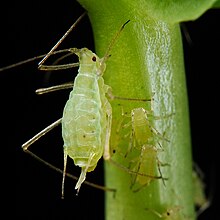
Anyone who studies biology for long enough realizes that eventually an exception is discovered for almost every "rule". We all learned that one of the things that separates animals from plants, protists and bacteria is that they are heterotrophs - no photosynthesis for bunnies and jellyfish. Except recently researchers have discovered that aphids (those tiny green insects that crawl all over your tomato plants) might be able to do photosythesis. Aphids can synthesize carotenoids (orange pigments), and these aphids made more ATP when placed in light then when they were moved into the dark. Now they have to figure out how the process works.
Thursday, May 3, 2012
SCVTS Art Show Invaded by Budding Scientists
For the first time some of our ABMS students have decided to enter artwork into the SCVTS art show on May 3. The chemistry 102 students had completed a periodic table printmaking project, and hung it up for display. Tiles from past classes will also be on display.
We are not sure if there are any prizes awarded at this art show, but as far as I'm concerned these guys win the Au.
Tuesday, April 17, 2012
Philadelphia Science Festival
The second annual Philadelphia Science Festival is taking place from April 20-April 29 in locations all over Philadelphia and its suburbs. There will be various workshops, lectures, museum tours and movies all about science.
The biggest event is on April 21, the Science Carnival. There will be demonstrations and interactive experiments all over Logan Circle in Philadelphia with real scientists, engineers and mathematicians guiding you along the way.
Friday, February 24, 2012
UPDATE: Speeding past the speed of light?
They are still going to redo the experiment in May, with all the cables plugged in correctly to see if they can replicate their results. Don't count them out yet!
Friday, February 10, 2012
How Your Cat May be Making You Crazy
The conventional wisdom has been that toxoplasmosis infections don't really cause harm to healthy people, but it seems that those conclusions may have been misguided. Toxoplasma infections are now strongly linked with some forms of mental illness such as schizophrenia, as well as to brain cancer.
Subscribe to:
Comments (Atom)